

Avio S.p.A Vega-C PLATiNO-2
Vega-C


Status
TBD
Date
30 NOV 2027
00:00

Mission Overview
PLATiNO-2 is an Earth observation satellite developed for the Italian Space Agency (ASI), making use of the PLATiNO minisatellite platform - a versatile and modular small satellite system - to support a variety of space missions for Earth observation, telecommunications, and scientific research. The platform offers a scalable and cost-effective solution for payload integration in support of diverse mission requirements and orbital configurations, with a focus on high performance, flexibility, and reliability, for both governmental and commercial applications. The PLATiNO-2 mission carries a Thermal Infrared (TIR) payload, validating PLATiNO multi-applicability feature. Developed by Leonardo and SITAEL, PLATiNO-2 TIR will acquire images that will be used to provide valuable services for territories control and protection such as monitoring waters, glaciers, pollutants, state of crops and vegetation, energy consumption in urban areas. PLATiNO-2 is also equipped with the magnetically shielded HT 100, an improved version of SITAEL electric thruster, making PLATiNO-2 one of the first missions in the world to observe the Earth in the Thermal Infrared from a very low orbit – less than 400 km – and thus significantly improving the resolution of the acquired images. The satellite also carries NASA’s Multi-Angle Imager for Aerosols (MAIA) instrument, which will study how different types of particulate matter air pollution affect our health.
Rocket
Vega-C
Mission Type
Earth Science
Orbit
Sun-Synchronous Orbit
Stages
4
Livestream
Not availableRocket Details
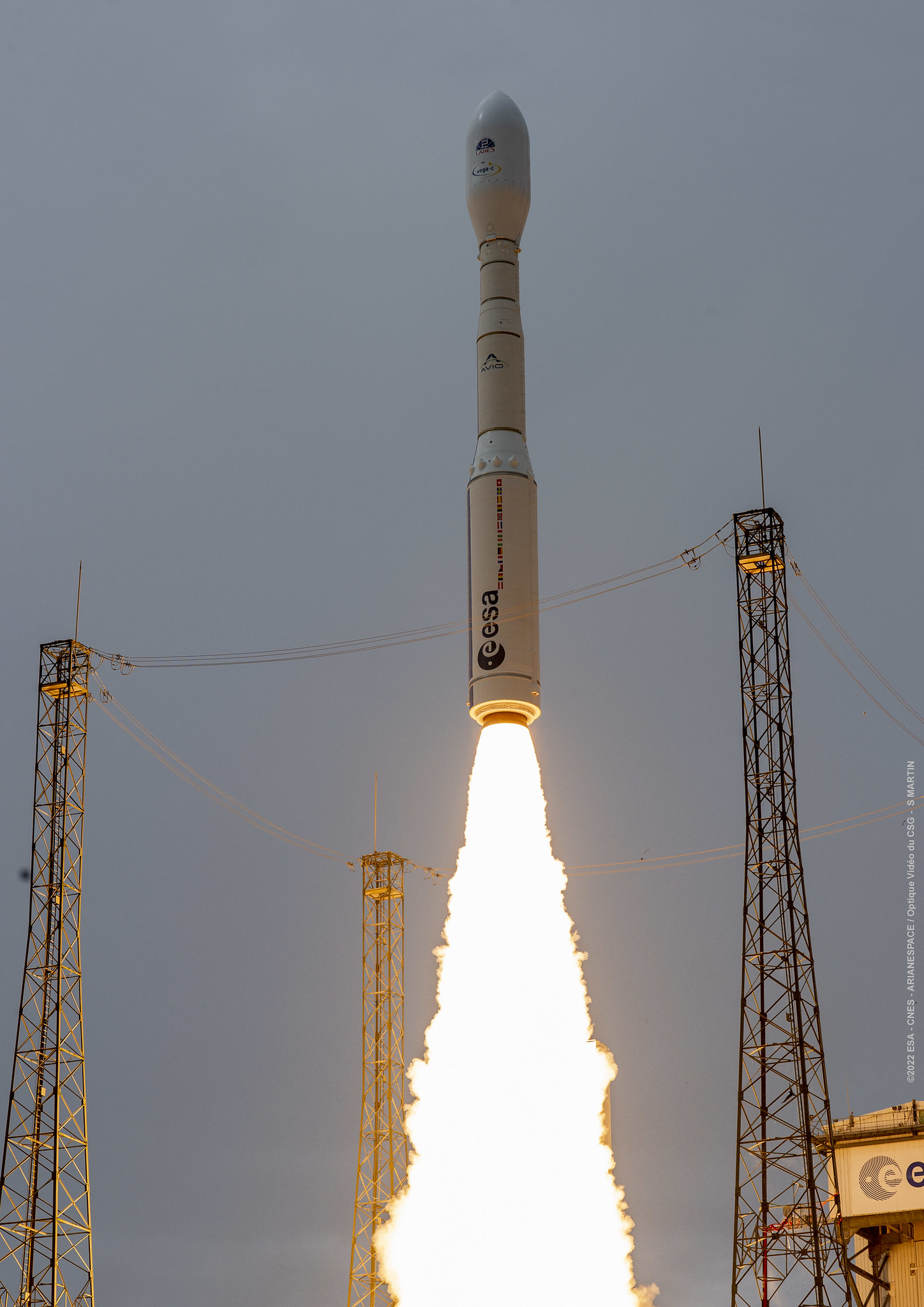
Vega-C is a single-body rocket nearly 35 m high with that weighs 210 tonnes on the launch pad. As with Vega, its main elements are three solid-propellant stages, an upper stage powered by a reignitable liquid-propellant engine and a payload fairing. Vega-C's P120C first stage replaces Vega’s smaller P80 to provide a significant increase in thrust at liftoff. It is also used as boosters (2 or 4) for the Ariane 6 rocket.
Height
34.8 m
Diameter
3 m
Launch Mass
210 T
Thrust
2,974 kN